Last updated October 15, 2026
ADU Warning Signs: A West Covina Homeowner’s Reference Guide
Most homeowners don’t know what a properly flashed window looks like, which means they can’t tell when it’s wrong. And the window to make a warranty claim closes faster than the leak it’s hiding. In West Covina, where summer heat regularly pushes past 95 degrees and winter rains test every seam, a small flashing error becomes a structural problem within two seasons. This guide gives you the vocabulary and the visual references to tell the difference between a punch-list item and a defect your contractor needs to fix before the guarantee expires, and you can find more guides & resources on our blog. You’ll learn what to look for by trade, how to document what you find, and when to stop taking photos and start making calls.
Quick Answer
The most serious ADU warning signs in West Covina fall into four categories: stucco cracks wider than 1/16 inch that follow diagonal patterns, flashing gaps you can see from the ground, interior stress cracks that appear within the first six months, and any electrical or plumbing behavior that trips a breaker or backs up a drain. For a deeper look at the full project lifecycle, see The Complete Guide to ADU in West Covina. Document everything with dated photos, notify the contractor in writing, and escalate to a licensed inspector if the defect involves structure, gas, or electrical work. Most one-year workmanship guarantees, including The Garrison Standard, require written notice before the term expires.
Table of Contents
- Exterior Warning Signs: Stucco, Flashing, and Grading
- Interior Warning Signs: Cracks, Racking, and Sweating Ducts
- Electrical and Plumbing Red Flags You Can Spot Without Opening a Wall
- How to Document a Defect So a Contractor Can’t Claim Ignorance
- When to Call a Licensed Inspector Before Confronting the Contractor
- Prefab and Modular ADU Warning Signs: Abodu, Cover, and Dvele
- The West Covina Defect Timeline: What Goes Wrong When
Exterior Warning Signs: Stucco, Flashing, and Grading
West Covina’s climate punishes exterior mistakes fast. We get hot, dry summers that bake stucco, followed by winter rain that finds every gap. The first thing to know about stucco cracks: not every crack is a problem. Hairline cracks under 1/16 inch that run vertically or horizontally near corners are usually cosmetic, from normal curing and thermal expansion. They show up in the first year and stop moving. Cracks wider than 1/16 inch that run diagonally from a window corner or door frame are a different animal. Those indicate movement, either in the framing or the foundation, and they deserve a structural engineer’s eye.
Flashing is where we see the most avoidable damage in West Covina ADUs. Flashing is the metal or tape that directs water away from joints where the roof meets a wall, around windows, and at the base of exterior walls. You should be able to see flashing at the head of every window and door from the ground. If you can see a gap between the window frame and the stucco, or if the flashing tucks behind the window instead of lapping over it, water is getting in. We’ve seen ADUs in West Covina with window flashing installed backward, where every rainstorm feeds water into the wall cavity. The homeowner doesn’t know until the drywall bubbles six months later.
Grading is the simplest thing to check and the most commonly ignored. Walk around your ADU after a rain. Water should flow away from the foundation on all four sides. If you see puddles sitting against the slab, or if the soil slopes toward the building, that water is finding its way under the footing. In West Covina’s clay-heavy soils, which expand when wet and shrink when dry, poor grading causes slab movement that shows up as those diagonal stucco cracks. A proper grade drops at least 6 inches over the first 10 feet from the foundation. If yours doesn’t, the contractor skipped a basic step.
Interior Warning Signs: Cracks, Racking, and Sweating Ducts
Inside the ADU, the first six months tell you most of what you need to know. Nail pops, those small circular bumps or holes that appear on drywall, are normal in new construction. They happen when lumber shrinks as it dries and the drywall fastener stays put. A few scattered nail pops are a punch-list item, easily fixed with drywall mud and paint. But stress cracks, meaning cracks that run diagonally from the corners of doors and windows or across the ceiling in a stair-step pattern, are not punch-list items. Those indicate the framing is moving beyond normal settling, and they will keep coming back until the underlying cause is addressed.
Door frames that rack within six months are another signal. Racking means the door no longer sits square in its frame. You’ll notice the gap between the door and the jamb is wider at the top than at the bottom, or the latch no longer catches without lifting the handle. In a properly framed ADU, doors stay square. If two or more interior doors are racking, the framing or the foundation is moving, and that’s a conversation with the contractor that needs to happen in writing.
Sweating HVAC ducts are common in West Covina because of our summer humidity. But there’s a difference between ducts that sweat and ducts that never stop sweating. If you see condensation on exposed ductwork in the attic or crawl space, or water stains on the ceiling below a duct run, the ducts are either uninsulated, improperly sealed, or undersized for the unit. Each of those is a defect, not a nuisance. A properly installed duct system in a West Covina ADU is sealed at every joint, insulated to code, and sized to the load calculation for that specific structure. If the contractor won’t show you the load calculation, that’s your answer.
Electrical and Plumbing Red Flags You Can Spot Without Opening a Wall
You don’t need to be an electrician to spot most electrical problems in a new ADU. Start with the breakers. In West Covina, city code requires AFCI, meaning arc-fault circuit interrupter, protection on most interior circuits. AFCI breakers trip when they detect an electrical arc, which is the precursor to a fire. If an AFCI breaker trips repeatedly on a circuit with minimal load, something is wrong. It could be a loose connection, a nail driven through a wire, or a defective breaker. A breaker that trips once is a mystery. A breaker that trips weekly is a defect.
GFCI outlets, the ones with the reset and test buttons, should be installed anywhere water is present: kitchens, bathrooms, laundry areas, and exterior outlets. Test them. Press the test button, the outlet should click and lose power. Press reset, it should come back. If the GFCI doesn’t trip when tested, it’s wired wrong or failed. That’s a defect, full stop, and it’s the kind of thing a contractor fixes under the one-year guarantee without argument.
Plumbing gives you visual and auditory clues. Slow drains in a new unit are not normal. New drain lines in a newly constructed ADU should flow freely. If a sink or shower drains slowly from day one, the waste line probably has improper slope, a low spot, or a partial blockage from construction debris. Watch for gurgling, too. When you drain the kitchen sink and the shower drain gurgles, the venting is inadequate. Vents let air in so water flows out. Poor venting is a code violation and a workmanship defect.
The water heater TPR valve, the temperature and pressure relief valve, is the small brass valve on the side or top of your water heater with a discharge pipe attached. That pipe must run to the exterior or to a floor drain, and it must slope downward. If the TPR discharge pipe points up, terminates inside a wall, or is capped off, that’s a serious safety defect. A TPR valve is the last line of defense against a water heater explosion. In West Covina, where water heaters often run hot to serve long pipe runs, this matters more than most people realize.
How to Document a Defect So a Contractor Can’t Claim Ignorance
Most guarantee disputes don’t fail because the contractor is dishonest. They fail because the homeowner never put the problem in writing. The Garrison Standard, like most reputable workmanship guarantees, starts with written notice. If you call and leave a voicemail, the contractor can claim they never received it. If you send an email, there’s a record. Here’s the process that protects you:
- Photograph first, photograph everything. Take photos of the defect from multiple angles, with a reference object for scale. A quarter or a coin next to a crack shows width. A level placed against a door frame shows racking. Date the photos, and keep them in a folder.
- Write a description that names the location and the symptom. “Stucco crack running diagonally from the northwest window corner, approximately 14 inches long, wider than 1/16 inch.” The more specific, the harder to dismiss.
- Send notice by email and request a read receipt. Email creates a timestamp. If you’re dealing with a company that prefers text, fine, but screenshot the thread. If they insist on phone calls, follow every call with a one-line email: “Per our call today, we discussed the stucco crack at the northwest window.”
- State the date you first noticed the defect. The guarantee clock runs from when you report the issue, not when the contractor decides to acknowledge it. If you noticed a crack in month five and report it in month eleven, you’re still inside the year, but the sooner the better.
- Request a written response within a specific window. “Please confirm in writing within 14 days whether this falls under the workmanship guarantee.” This sets a clock on their end.
- Keep a log. Every call, every email, every visit. Date, time, person, what was said. If the dispute escalates, this log is your evidence.
West Covina homeowners have additional protection under California law. The Right to Repair Act, also known as SB 800, establishes specific performance standards for new residential construction and a process for resolving defects. Under SB 800, a contractor has the right to inspect and offer a repair before you sue, but you have to follow the notice process. Documenting everything doesn’t just protect your guarantee claim, it preserves your legal position if the contractor refuses to honor it.
When to Call a Licensed Inspector Before Confronting the Contractor
Some warning signs you can photograph and describe yourself. Others should be evaluated by a licensed professional before you have the conversation with your contractor. The rule of thumb: anything involving structure, gas, or life safety goes to an inspector first. Here’s the breakdown.
Call a licensed structural engineer if you see diagonal stucco cracks wider than 1/16 inch, racked door frames, stair-step cracks in block or brick, or any crack that widens over time. A structural engineer will tell you whether the movement is normal settlement or a framing or foundation problem. That report is worth its weight when you sit down with the contractor, because it converts “I think something’s wrong” into “a licensed engineer says something’s wrong.”
Call a licensed electrician if you have repeated AFCI trips, warm outlets, a burning smell from any switch or receptacle, or flickering lights that affect multiple circuits. Don’t open the wall yourself. Don’t let the contractor’s guy open the wall before you’ve had an independent look. Once the wall is open, the evidence can be disturbed.
Call a licensed plumber if you have sewage smells, slow drains throughout the unit, water heater issues, or any sign of water under the slab. A plumber with a camera can inspect the waste lines without opening the floor. If the camera finds a low spot or a separated joint, you have documented proof of a defect that the contractor can’t argue with.
If you’re in West Covina and you’re not sure which category your problem falls into, call the city’s Building and Safety Division. They keep records of every permit pulled on your property, and they can tell you whether the work was inspected and signed off. If the contractor told you permits were pulled and they weren’t, that’s a red flag that changes the entire conversation.
Our team at Fielding ADU West Covina home has walked through enough of these situations to know: the homeowner who documents early and escalates correctly is the one who gets the repair done. The one who waits hoping it’ll stop is the one who ends up paying for a re-fix out of pocket.
Prefab and Modular ADU Warning Signs: Abodu, Cover, and Dvele
West Covina has seen a wave of prefab and modular ADUs go up in the last five years, with good reason. A factory-built unit like an Abodu, Cover, or Dvele goes up faster than a stick-built ADU and arrives with its own warranty. But prefab units have their own warning signs, and most of them show up at the foundation and the marriage line, where the modules join together.
For a factory-built unit, the foundation is everything. The modules are built to tight tolerances in a controlled environment. If the foundation is even slightly out of level, the modules won’t seat correctly. Look at the marriage line, the seam where two modules come together. You should see a clean, consistent joint. If the seam is wider at one end than the other, or if you see daylight through any part of it, the foundation is off. That’s a foundation contractor defect, separate from the module warranty, and it needs to be addressed before the modules settle into the misalignment.
Check the utility connections, especially the point where the factory plumbing meets the site plumbing. Factory-built modules are pressure-tested at the plant, but the site connection is done by hand. A slow drain that starts right after the connection point is almost certainly a site-work defect, not a factory defect. The same applies to electrical connections at the main panel. If breakers trip only on circuits that cross the module-to-site boundary, look at the junction work, not the factory wiring.
Roof lines on modular units should be straight and true. If you see a sag or a dip where two modules meet, that’s a structural issue. If you see water staining at the roof marriage line after the first winter rain in West Covina, the roofing membrane joint was installed wrong. For units built by Dvele or Abodu, the factory warranty covers the module. The site warranty, the work done by the local contractor, is where most West Covina prefab owners run into trouble. That’s why the written guarantee on the site work matters as much as the factory warranty on the box.
We work with these platforms directly, including Cover and Dvele, so we understand where the factory warranty ends and the site contractor’s responsibility begins. If you’re looking at a prefab ADU and want to understand how the pieces fit together before you sign, our ADU Builders in West Covina page walks through the options without the sales pressure.
The West Covina Defect Timeline: What Goes Wrong When
Defects have a rhythm. They show up on a predictable schedule, and knowing that schedule helps you look for the right thing at the right time. Here’s what we’ve seen in West Covina across hundreds of ADU projects and what we’ve been called in to fix when someone else’s work failed.
Months 1-3: The obvious stuff. This is when construction debris in drain lines shows up as slow drains, when bad paint peels, when a cabinet door that was hung crooked starts to irritate you. These are punch-list items, the kind of thing a reputable contractor fixes without argument. Document them, send one consolidated list, and ask for a scheduled repair visit. Don’t call one at a time.
Months 4-6: Movement and moisture. The first full season change stresses everything. Summer heat expands stucco, winter rain finds flashing gaps. This is when diagonal stucco cracks appear if the framing is moving, when window flashing errors turn into water stains on interior drywall, when door frames start to rack. If it’s going to fail from movement, it fails in this window.
Months 7-12: Electrical and HVAC gremlins. Repeated AFCI trips that were dismissed as nuisance trips are now a pattern. The HVAC system has run a full summer and a full winter, and sweating ducts have made their mark. This is also when water heater problems show up, because the unit has cycled enough times to reveal a bad install.
After year one: The guarantee expires. Many defects that were visible in months 7-12 don’t get reported until month 14, when the one-year mark has passed. That’s why month 11 is the critical moment. Walk your ADU with fresh eyes. Look at every wall, every window, every outlet. If you see something, send that written notice before the year is up. The Garrison Standard is typical of reputable guarantees in this respect: if you don’t report the defect inside the term, you lose the claim, even if the defect itself started earlier.
What a Properly Built ADU Looks Like in West Covina

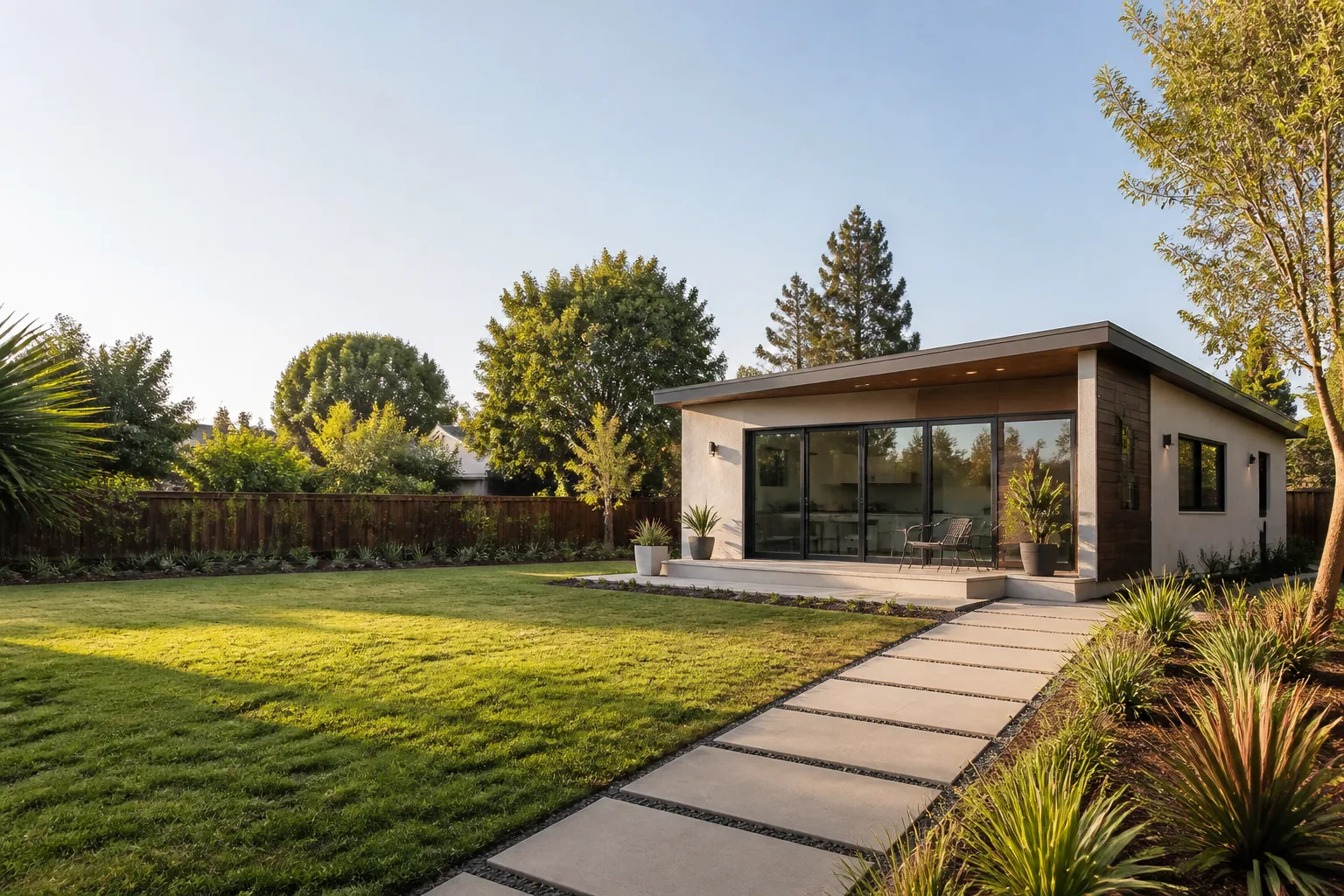
It helps to know what right looks like, because that’s the baseline for spotting what’s wrong. A properly built ADU in West Covina has flashing that laps over, not under. The grade slopes away from the foundation on all sides. The stucco is free of diagonal cracks, and any hairline cracks are stable and under 1/16 inch. Interior doors hang square and stay square. Drains flow freely, vents don’t gurgle, and the water heater TPR pipe drains to the exterior with a downward slope.
On the mechanical side, a proper ADU has a load calculation on file, and the contractor can show it to you. The electrical panel is labeled clearly, every circuit is AFCI or GFCI protected where code requires, and no junction boxes are buried behind drywall. The HVAC ducts are sealed at every joint with mastic, not tape, and insulated where they run through unconditioned space.
For prefab units like those from Abodu, Cover, or Dvele, the marriage line is tight and consistent, the roof line is straight, and the site connections are clean and accessible. The factory warranty documents are in a folder, and the site contractor’s written guarantee is in the same folder. If you’re comparing what you have to what right looks like, a good place to start is our Room Addition Contractor in West Covina guide, which goes deeper into the build standards we hold ourselves to.
Common Mistakes to Avoid
- Waiting until month 13 to report a defect you saw in month 8. The guarantee clock is running from day one. Report any defect the week you notice it, not the week the contractor is already gone.
- Letting the contractor’s crew “fix” a structural crack with caulk and paint. Caulk hides evidence. It doesn’t fix movement. If the crack comes back, you’ve lost the photo evidence that showed the original condition.
- Accepting a verbal promise to fix something later. “We’ll get that on the next visit” is not a guarantee claim. Put it in writing, even if it’s just an email confirming the conversation.
- Assuming all stucco cracks are the same. Hairline shrinkage cracks are normal. Diagonal cracks wider than 1/16 inch are not. Treating them the same wastes your guarantee window on the wrong issue.
- Paying the final invoice before the punch list is done. Once the money is all gone, your leverage is gone with it. Hold back the final payment until the punch list is complete and documented.
- Not pulling the permit records before the contractor disappears. West Covina permits are public record. If the work wasn’t inspected and signed off, you have a bigger problem than a cracked stucco patch.
When to Call a Professional
If you see a diagonal stucco crack wider than 1/16 inch, a racked door frame, or any sign of water intrusion after the first rain, stop taking photos and call a professional. If your AFCI breaker trips more than twice in a month, if you smell gas anywhere near the water heater, if your drains gurgle every time the washing machine runs, the time for amateur diagnosis is over. Fielding ADU West Covina offers free estimates for ADU inspections and warranties in West Covina, whether we built the unit or not. If you want a second set of trained eyes on someone else’s work before you confront them, call (559) 238-9583. Our crew is background-checked, uniformed, and we’ll give you a written report, not a sales pitch.
Frequently Asked Questions
A stucco crack is serious if it’s wider than 1/16 inch, runs diagonally, or grows over time. Hairline cracks that run vertically or horizontally near corners are usually cosmetic shrinkage from normal curing. Diagonal cracks, especially those radiating from window corners or door frames, indicate structural movement and should be evaluated by a licensed engineer. In West Covina’s clay soils, these cracks often point to foundation movement caused by expanding and contracting soil.
Ask them to put that statement in writing with a commitment to repair if the crack widens. Normal settling produces hairline cracks that stop moving within the first year. Movement cracks widen, lengthen, or spawn new cracks from the same point. If the contractor won’t put “just settling” in writing, that’s your signal to bring in an independent structural engineer and document everything. Call (559) 238-9583 if you want an unbiased look at what the crack is actually doing.
Yes, if the flashing was installed wrong in the first place, that’s a workmanship defect and it falls inside a properly written one-year guarantee like The Garrison Standard. The catch is that you have to report it in writing before the year expires. If you wait until the water stain spreads across the ceiling in month 16, most contractors will argue the damage happened after the guarantee expired. Report the stain the week you see it, and photograph it from multiple angles.
The factory-built modules are generally built to tighter quality control than stick-built structures, so factory defects are less common. But the site work, meaning the foundation, the utility connections, and the marriage line sealing, is done by local crews and carries the same risk as any construction. Most prefab ADU problems we see in West Covina are site-work defects, not factory defects, and those fall under the site contractor’s guarantee, not the factory warranty. Our Garage Conversion Contractor in West Covina page explains how the site work differs from a conversion.
Under California’s Right to Repair Act, known as SB 800, the statutory warranty periods vary by defect type. Most fit and finish items carry a one-year warranty, plumbing and electrical systems carry two years in many cases, and structural defects can be actionable for up to ten years. But your written one-year workmanship guarantee has its own clock. Report the defect in writing before that year expires, and you preserve both your guarantee claim and your SB 800 rights.
Technically yes, but you shouldn’t, if the contractor is still inside the guarantee period. Any repair you make can void the contractor’s responsibility for related damage. If you caulk a flashing gap yourself and water still gets in, the contractor can claim your repair was the problem. Document the gap, send the written notice, and let the contractor fix it under the guarantee. If they refuse or drag their feet past the response deadline, that’s when you bring in a third-party contractor and send the bill along with your documentation.
The Bottom Line

Most West Covina ADUs are built without major problems. The ones that do have problems share a pattern: the warning signs were visible early, and nobody reported them in writing until after the guarantee expired. You now know what a properly flashed window looks like, how wide a stucco crack can be before it signals movement, and why a gurgling drain in a new unit is a venting defect, not a quirk. The guarantee is only worth what you document. Walk your ADU every month for the first year, photograph anything that changes, and send written notice the day you find something. If you want a trained set of eyes on the situation, Fielding ADU West Covina is at (559) 238-9583, and the estimate is free. For guidance on selecting the right professional, read How to Hire a ADU Contractor in West Covina: A Step-by-Step Guide.
Written by Reed Calloway, Owner at Fielding ADU West Covina, serving West Covina since 2006.