Last updated October 15, 2026
DIY vs Professional ADU: The West Covina Homeowner’s Decision Guide
Here’s a fact most ADU guides won’t tell you: the West Covina building department does not actually care how handy you are. What it cares about is the name on the permit application. A homeowner who frames a wall beautifully but pulls the permit under their own name with no contractor’s license will, in most cases, be stopped before they start. Meanwhile, a homeowner who hires a licensed contractor to close out the permit, then swings a paintbrush themselves, keeps every dollar they save and stays fully legal. This guide draws that line precisely: what you can legally do yourself on an ADU in West Covina, what you cannot, what each path actually costs, and where owner-builder projects in this city have gone wrong. For more guides & resources, see our blog.
Quick Answer
In West Covina, the DIY-versus-professional ADU decision is not really about skill, it’s about permit law. California lets an owner-builder pull an ADU permit without a contractor’s license, but West Covina requires a signed owner-builder declaration, and if you plan to rent the unit or sell within a few years, self-performed electrical, plumbing, and structural work creates liability and disclosure burdens most homeowners do not want. The practical answer for most people: hire a licensed contractor to handle permit, foundation, framing, and MEP (mechanical, electrical, plumbing) work, then self-perform finish tasks like painting, trim, landscaping, and hardware after final inspection. That split saves real money without putting the property or the permit at risk.
Table of Contents
- What West Covina Law Actually Allows an Owner-Builder to Do
- The Owner-Builder Declaration You Have to Sign
- Who Is the Contractor of Record, and Why Does It Matter?
- The Real Cost Comparison: Owner-Builder vs Licensed Contractor
- Finish Work You Can Legally Do After Final Inspection
- Three Owner-Builder ADU Stalls in West Covina and What They Cost
- Resale and Liability: What Follows the Property
- Common Mistakes to Avoid
- When to Call a Professional
- Frequently Asked Questions
- The Bottom Line
What West Covina Law Actually Allows an Owner-Builder to Do
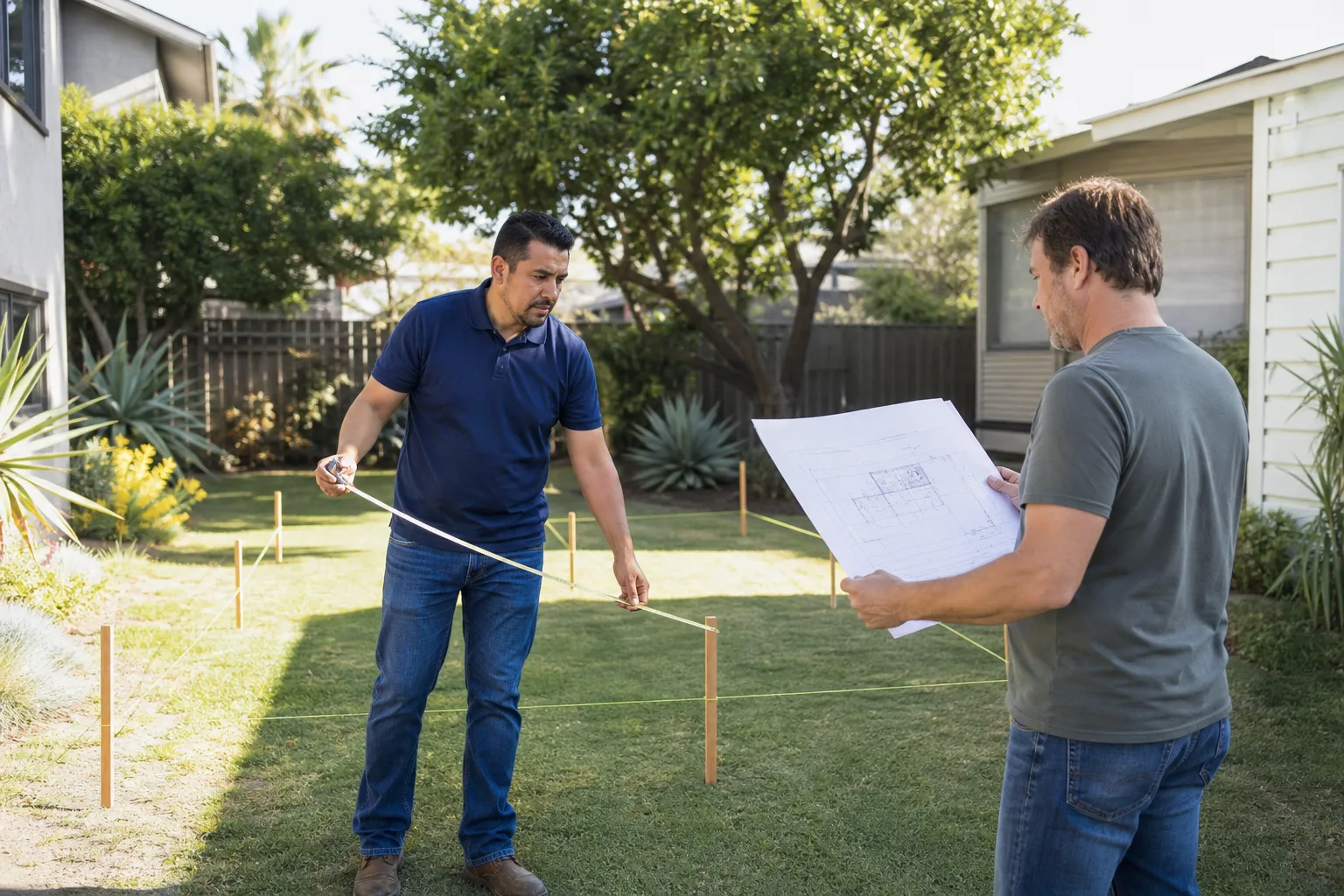
California Health and Safety Code Section 17921 lets a property owner act as their own general contractor on an ADU, provided the unit is on their own property and they are not building it primarily for sale. That’s state law. West Covina, like most LA County cities, does not override that right. What West Covina does require is that the owner-builder personally appear at the building counter, sign a declaration under penalty of perjury, and accept responsibility for the work as if they were a licensed contractor. That’s the threshold question: are you willing to be legally responsible for the structure, the electrical system, the plumbing, and the sewer connection, in writing, under oath?
In our experience at ADU Builders in West Covina, most homeowners who walk in expecting to self-perform the whole job walk out reconsidering after they read the declaration. It is not a formality. It makes you the general contractor in the eyes of the city, which means you schedule inspections, you correct every correction notice, and you carry the liability for any unpermitted work a subcontractor does on your property.
Here is what an owner-builder in West Covina can legally self-perform:
- Acting as the general contractor: hiring, scheduling, and paying licensed subcontractors for trades the city requires to be licensed
- Painting, drywall finishing, and texture work (no license required)
- Finish carpentry: baseboards, crown molding, door casings, closet shelving
- Landscaping, grading for drainage under 12 inches, and hardscape paths
- Cabinet installation, countertop installation, and appliance hookups after final plumbing inspection
- Flooring: tile, laminate, vinyl, and engineered wood (though not the subfloor or structural floor system)
Here is what an owner-builder in West Covina cannot legally self-perform:
- Electrical work beyond replacing a fixture or outlet: new circuits, subpanels, service upgrades, any wiring inside walls
- Plumbing work beyond replacing a faucet or P-trap: new supply lines, drain-waste-vent systems, gas lines, water heater installation
- Structural framing, foundation work, or shear-wall installation
- HVAC installation or duct modification
- Roofing and waterproofing on the ADU envelope
These restrictions are not West Covina being strict. They’re California law. The trades that require licensing are the ones where a mistake can kill someone or flood a neighbor’s property. The city is not trying to protect you from a bad paint job; it’s trying to protect the next buyer from an electrical fire.
The Owner-Builder Declaration You Have to Sign
If you pull an ADU permit as an owner-builder in West Covina, you sign a document that most people have never heard of until they’re standing at the counter: the Owner-Builder Verification form. It states, under penalty of perjury, that you own the property, you will occupy the ADU or use it for personal purposes, and you are not building it for sale. The last clause matters more than people think.
- You confirm you are the legal property owner and the ADU is on your land.
- You confirm you will not sell the property within one year of completion. If you do, the new owner may have claims against you for construction defects, and you lose certain legal protections a licensed contractor’s insurance would have provided.
- You accept full responsibility for all work performed, including work done by any unlicensed helper you bring on site.
- You agree that workers’ compensation insurance is not provided by you unless you purchase it separately. If a laborer you hire gets hurt on your ADU, they can file against your homeowner’s insurance.
That last point is the one that surprises people. Hiring a day laborer to help you lift drywall panels is normal. What’s not normal is that if that person falls off your ladder, your homeowner’s policy may deny the claim because the work was part of an active construction project, and the city will point to the declaration you signed. A licensed contractor carries workers’ compensation for exactly this reason. The owner-builder declaration is not a permission slip. It’s a liability transfer.
Who Is the Contractor of Record, and Why Does It Matter?
Every ADU permit in West Covina has a “contractor of record” line. If that line is blank, it means you, the owner, are the contractor of record. That single line determines who the inspector calls when something fails, who the city holds responsible for code violations, and whose name appears on every document until the certificate of occupancy is issued.
When Fielding ADU West Covina serves as the contractor of record on a project, the city knows where to send the correction notice. The inspector’s phone call comes to our office, not your kitchen. The corrections, re-inspections, and scheduling headaches are ours, not yours. That’s the single biggest invisible cost of going owner-builder: the hours you spend on hold with the building department, the days you take off work to meet inspectors, and the re-work you eat when a contractor you hired cuts a corner you didn’t know to check.
Count on this: the average West Covina ADU permit involves between 8 and 14 separate inspections, spread across foundation, framing, shear wall, electrical rough, plumbing rough, mechanical, insulation, drywall, and final. Each inspection window is a 4-hour block. If the inspector fails one trade, the next trade’s inspection usually gets blocked until the correction is cleared. An owner-builder managing inspections on a 10-inspection ADU can easily spend 40 to 60 hours of weekday time just on inspection scheduling, not counting the time it takes to understand what the inspector wants.
That’s the distinction most cost comparisons miss. The material and labor dollars are not the whole number. Your time is in the number whether you write it down or not.
The Real Cost Comparison: Owner-Builder vs Licensed Contractor
Here is a realistic cost comparison for a 600-square-foot attached garage conversion ADU in West Covina, based on current market rates in the San Gabriel Valley. These are planning ranges, not quotes, but they reflect what we see on permits and subcontractor bids in this city.
- Licensed contractor-managed garage conversion: $160,000 to $220,000, including permits, plans, engineering, all trades, and project management. Timeline: 6 to 10 months.
- Owner-builder garage conversion with licensed subs: $120,000 to $180,000 in hard costs, plus 40 to 60 hours of owner project management time, plus the cost of any mistakes the owner absorbs. Timeline: 9 to 16 months, and it’s rarely the lower number.
- Owner-builder with heavy self-perform on finishes only: $105,000 to $150,000 in hard costs, plus the same time burden, but finish work saved is $15,000 to $30,000 in labor. This is the rational middle path.
The gap between owner-builder and contractor-managed looks like $40,000 to $60,000 on paper. Subtract the value of your own project management time at even $50 an hour, and you’ve burned $2,000 to $3,000 before the first wall goes up. Subtract the cost of one failed inspection that stalls the project three weeks while you find a subcontractor to fix someone else’s work, and you can see how the gap narrows fast.
There’s a cleaner split. It’s the one we recommend to West Covina homeowners who call Fielding ADU West Covina home asking whether they can do part of the work themselves. Let a licensed contractor take the project from permit through final inspection. Then, after the certificate of occupancy is in hand, self-perform the finish tasks. That’s where the real savings live, and it’s the only version of “DIY ADU” that doesn’t put your permit, your schedule, or your resale value at risk.
Finish Work You Can Legally Do After Final Inspection
Once the West Covina building inspector signs the final inspection and the certificate of occupancy is issued, the construction code’s grip on the project loosens. See our Room Addition Contractor Maintenance Checklist for West Covina Homeowners for related guidance. The building is legally habitable. Everything after that point is cosmetic, and the city does not care who does it. This is where the DIY budget actually makes sense.
Here is what any West Covina homeowner can legally self-perform after final inspection, with zero permit implications:
- Interior painting. Walls, ceilings, trim, doors. The most accessible savings, and the easiest to do wrong slowly rather than dangerously wrong.
- Finish carpentry. Baseboards, shoe molding, window casings, closet systems, shelving.
- Flooring. LVP, laminate, engineered wood, tile over an approved substrate. Not the subfloor, not the structural floor diaphragm, but the wear layer.
- Cabinet and countertop installation. Cabinets go in after plumbing and electrical rough inspections are signed off. Countertops follow cabinets. Both are finish work.
- Hardware and fixtures. Faucets, shower heads, towel bars, door handles, light fixture swaps (replacing one approved fixture for another).
- Landscaping and exterior finishes. Plants, mulch, pavers, decorative gravel, exterior paint on non-structural surfaces.
- Window coverings and closet doors. Anything that mounts to finished surfaces and does not penetrate fire-rated assemblies.
The line is: if it touches structure, waterproofing, fire rating, electrical supply, or plumbing supply, it needs to be done before final inspection by a licensed trade. If it touches appearance only, you can do it on a Saturday after the inspector leaves.
That’s the honest answer to “can I DIY my ADU in West Covina?” You can DIY the parts the city doesn’t regulate, and the city doesn’t regulate the part most homeowners actually enjoy. The temptation is to push that line earlier, to pull some wiring or move a drain line yourself before the rough inspection. Don’t. That’s where owner-builder projects in this city get expensive.
Three Owner-Builder ADU Stalls in West Covina and What They Cost
These are three scenarios we’ve seen on projects in West Covina, either when we were called in to fix a stalled owner-builder job or when a homeowner came to us after burning out. Names and addresses are not included, but the numbers are real.
- Unpermitted electrical rough-in. An owner-builder in the Woodside neighborhood pulled the ADU permit and hired an unlicensed handyman to run new circuits in the kitchen and bath. The rough electrical inspection failed immediately: Romex gauges were wrong, the panel was overloaded, and the city flagged the work as unperformed by an unlicensed contractor. The correction required tearing out drywall, pulling all the wiring, and re-doing it with a licensed electrician. Total cost of the fix: $8,700. Total schedule delay: 11 weeks.
- Subcontractor abandonment. An owner-builder hired the lowest bidder for foundation and framing on a detached ADU. The crew set the forms, poured a slab that was out of level by 1.5 inches across 20 feet, and then stopped returning calls. The city’s slab inspection failed, and no licensed contractor would take the job without tearing out the bad slab and starting over. The owner paid for the slab twice. Total cost: $14,200 before a new contractor even started.
- The self-performed shear wall. A homeowner with framing experience decided to install the panel shear walls themselves, a task that requires nail spacing and panel nailing patterns that an inspector checks hole by hole. The inspector failed the wall on nail overdrive: the nails were set too deep, reducing the plywood’s rated capacity. Every sheet had to be pulled and renailed. It sounds minor. In a 600-square-foot ADU, it was a $6,400 fix and a two-month delay, plus the engineer had to re-stamp the wall detail.
None of these failures were because the homeowner was lazy. They were because the homeowner was not a general contractor, and the city’s inspectors hold the same standard for owner-builders that they hold for licensed firms: the code is the code. The difference is that a licensed firm has already paid to learn these lessons on other projects. The owner-builder pays to learn them on their own property.
Resale and Liability: What Follows the Property
An ADU built by an owner-builder becomes a material fact at resale. When you sell a West Covina home with an ADU, the seller’s transfer disclosure statement asks whether the unit was built with permits and who performed the work. California Civil Code Section 1102 requires you to disclose known material facts about the property. An owner-built ADU is not automatically a defect, but it becomes one the moment something fails.
If the new buyer hires an inspector and the inspector flags electrical work that does not match the permit’s approved plans, or plumbing that was never signed off by the city, you are in a corrective situation, not a negotiation. The buyer can require repairs before close. The buyer can file a claim after close. The claim follows the property record, and your homeowner’s insurance may not cover it.
Self-performed electrical work is the most common liability. Under California law, unlicensed electrical work on a property you later sell is a disclosure item, and many buyers’ insurers will refuse to write a policy on a home with unpermitted electrical modifications. The same applies to unpermitted gas line work, sewer connections, and structural modifications.
Here’s the clean way to think about it: if the permit record shows our name as the contractor of record, and the final inspection is signed, the work is defensible. The plans are on file. The inspections are on record. The trades that did the work were licensed and insured. That record is transferable to the next owner and it makes the ADU an asset, not a question mark. If the permit record shows you as owner-builder, and something fails later, you are the one answering for it, whether you still own the house or not.
The finish work you do yourself after final inspection does not create this problem. Paint, flooring, cabinets, hardware: none of it touches the transfer disclosure statement the way electrical or plumbing does. That’s why the “contractor through final, owner for finishes” split is the one that protects resale value. For ongoing care tips, see our Seasonal ADU Care for West Covina: Year-Round Homeowner’s Guide.
A Self-Performance Checklist for West Covina ADUs
If you are considering the hybrid path, here is the sequence that keeps you legal and keeps the project moving.
- Hire a licensed contractor to handle plans, engineering, permit filing, and the contractor-of-record line on the application. This is the single most important decision in the project.
- Let the contractor and their licensed subs complete all foundation, framing, shear wall, electrical, plumbing, mechanical, insulation, and drywall work. Do not touch any of it.
- Schedule and clear every inspection through the contractor. You attend if you want to learn; you do not manage it.
- At final inspection, confirm the certificate of occupancy is issued with our name on the record, the plans on file, and the punch list cleared.
- After final: paint, trim, flooring, cabinets, counters, fixtures, hardware, landscaping. Take your time. No permit consequences.
- Keep the permit record and final inspection card with your property documents. It’s part of your resale package whether you plan to sell next year or in 20 years.
The sequence matters as much as the list. The moment a homeowner jumps ahead of final inspection to do a trade they’re not licensed for, the city’s correction process resets everything behind them. It’s not a shortcut. It’s a U-turn.
Common Mistakes to Avoid
- Pulling the permit as owner-builder to save the general contractor’s fee, then hiring the cheapest subs you can find. You’ve just accepted general-contractor liability while paying no one to manage the technical risk. West Covina inspectors fail owner-builder electrical and plumbing work at a high rate, and every failure is a correction on your schedule.
- Letting a “friend who does construction” run the project without a license. The city doesn’t care about the friendship. If the friend is not licensed, the city sees unlicensed contracting on your property, and any warranty the friend gives you is unenforceable. We’ve replaced work in West Covina that a “friend who does construction” left half done.
- Self-performing electrical or plumbing rough-in because “it’s just a few wires.” Rough-in electrical and plumbing are the exact trades with the highest inspection failure rate and the longest correction cycles. A failed rough-in stalls the next three trades. Textbooks don’t teach you what a West Covina inspector’s red-tag list looks like.
- Not accounting for the time cost of managing subcontractors. The 40 to 60 hours of inspection scheduling, bid comparison, and correction management is not free time. If you bill $60 an hour at your own job, you’ve spent $2,400 to $3,600 of your own time to save a management fee that a licensed contractor would have charged once and done.
- Skipping the permit entirely. We get calls from homeowners who built a “shed” that’s clearly an ADU, or converted a garage without permits, and now want to sell or rent it. The city’s enforcement process for unpermitted ADUs in West Covina starts with a correction notice and can end with demolition orders for the worst cases. The legalization path costs more than the original permit would have.
- Choosing the cheapest bid and not reading what’s excluded. Some bids look lower because the contractor excluded the sewer connection, the electrical service upgrade, or the permit fees. Then the number moves at the door. That’s exactly the experience our written-price policy exists to prevent.
- Believing a prefab ADU solves the permit problem. Prefab and modular ADU platforms like Abodu, Cover, and Dvele still require a site permit, a foundation, and utility connections in West Covina. The building arrives on a truck; the permit still has to be pulled and the inspections still have to pass. Prefab changes the schedule, not the paperwork.
When to Call a Professional
Call a licensed ADU contractor the moment the project involves any trade that touches structure, electricity, plumbing, gas, or waterproofing, which is to say, every ADU from foundation to drywall. West Covina’s inspectors expect a contractor-of-record on the permit for a reason: the city’s code enforcement is real, the correction process is expensive, and the liability follows the property.
Fielding ADU West Covina offers free estimates in West Covina, with the price in writing before any work starts. If you’re trying to decide between a garage conversion, a detached ADU, or a prefab unit, we’ll walk the lot with you and tell you what each path actually costs in this city. Call (559) 238-9583.
Frequently Asked Questions
Yes, California law allows an owner-builder to pull an ADU permit on their own property without a contractor’s license, but West Covina requires you to sign an owner-builder declaration accepting full legal responsibility for the work, and you cannot rent the unit out or sell the property within one year of completion without additional legal exposure. Most homeowners find the declaration’s liability terms heavier than expected. Call (559) 238-9583 if you want to walk through what this actually means for your property.
Self-performing only finish work after final inspection saves $15,000 to $30,000 on a 600-square-foot ADU in West Covina. Acting as owner-builder on the whole project saves $40,000 to $60,000 in hard costs, but you give back $2,000 to $3,000 in your own project management time and risk far more in failed inspections and rework.
No. Our price goes in writing before any work starts, and the number you approve on day one is the number on the final invoice. That’s the Garrison Standard, and it applies to every room addition project in West Covina we take on. No change orders, no door-price adjustments, no surprises.
Yes. Cabinet installation, countertops, flooring, paint, trim, and hardware are all finish work that any homeowner can legally do after the final inspection is signed. These tasks do not appear on the permit record and do not affect the certificate of occupancy.
The inspector issues a correction notice, the failed trade’s work is pulled out and redone by a licensed contractor, and every downstream inspection is blocked until the correction clears. We’ve seen corrections in West Covina run from $6,000 to $14,000 depending on the trade, with schedule delays of two to three months.
No. Prefab and modular ADU platforms still require a city permit, a foundation, and utility connections in West Covina. The factory builds the modules; the site work, inspections, and certificate of occupancy still have to pass the city’s process. A licensed contractor of record is still required on the permit. Our team works with Abodu, Cover, Dvele, and Mighty Buildings, so we can tell you what a specific platform costs to site and permit in West Covina. Call (559) 238-9583 for a written estimate.
The Bottom Line
The DIY-versus-professional ADU question in West Covina is settled by the permit process, not by your tool collection. Act as your own general contractor, and the city holds you to the same code standard as a licensed firm while you absorb all the liability. Hire a contractor through final inspection and self-perform the finishes, and you keep the savings without touching the risk. That’s the honest split, and it’s the one that protects your schedule, your inspection record, and your resale value. The finish work is yours. The permit, the structure, the electrical, the plumbing, and the paper trail: that’s what you hire a West Covina garage conversion contractor for. Get the price in writing, then pick up a paintbrush.
Written by Reed Calloway, Owner at Fielding ADU West Covina, serving West Covina since 2006.